You ask for a public defender at your first court appearance, usually called the initial appearance or arraignment, by telling the judge you cannot afford a lawyer. The court then has you fill out a sworn financial form, and if you qualify, a lawyer is appointed that day or soon after. If you are held after an arrest without a warrant, a judge generally must review probable cause within 48 hours.
Who has the right to a free lawyer
The Sixth Amendment gives people charged with crimes the right to a lawyer. In *Gideon v. Wainwright* (1963), the Supreme Court held that states must provide a lawyer to felony defendants who cannot afford one. In *Argersinger v. Hamlin* (1972), the Court extended that rule to misdemeanor cases that end in actual jail time.
The right starts early. In *Rothgery v. Gillespie County* (2008), the Court held that the right to counsel attaches at the first appearance before a magistrate, where the person learns the charge and the court restricts their liberty. That does not mean a lawyer must stand next to you at that first hearing in every state. It means the clock has started, and the court has to appoint counsel within a reasonable time so you are represented at the stages that matter.
In federal court, Federal Rule of Criminal Procedure 44 says a defendant who cannot obtain counsel is entitled to appointed counsel from the initial appearance through appeal.
Low-level cases are the gray area. If the charge cannot lead to jail, such as many traffic infractions, you usually have no right to an appointed lawyer, though some states provide one anyway.
How fast you see a judge after arrest
If you were arrested without a warrant and are still in jail, a judge must decide whether there was probable cause to hold you. In *County of Riverside v. McLaughlin* (1991), the Supreme Court said a hearing within 48 hours of arrest generally meets that requirement.
Two details matter. First, a hearing inside 48 hours can still be too slow if the delay was unreasonable, such as holding someone to gather more evidence. Second, after 48 hours the burden shifts to the government to show an emergency or other extraordinary circumstance. The Court said an intervening weekend does not count. Some websites say weekend arrests can wait 72 hours. That is not what the Court held.
Many states set their own, shorter deadlines by statute or court rule, and many counties hold first appearances every day, including weekends. In federal cases, Rule 5 requires that an arrested person be brought before a magistrate judge "without unnecessary delay."
If you were released with a citation or a summons, your first court date may be weeks away. You can still ask for a public defender before that date by calling the court clerk or the local public defender office.
Initial appearance vs. arraignment
People use these words loosely, and so do courts. In many places, the first hearing after arrest is called the initial appearance, first appearance, or bail hearing. The arraignment, where you enter a plea, may happen at that same hearing (common in misdemeanor cases) or at a later date after the prosecutor files formal charges (common in felony cases).
At the first hearing, the judge usually tells you the charges, explains your rights, decides release or bail, and deals with appointing a lawyer. At the arraignment, the judge reads or summarizes the charges and asks how you plead.
Many first appearances in jail are now done by video from the facility. The process is the same. You can still ask for a lawyer on the screen.
How to ask for a public defender, step by step
At the first hearing, say it out loud. When the judge asks whether you have a lawyer, say: "I cannot afford a lawyer. I am asking for a public defender." That is enough. You do not need a special form to make the request.
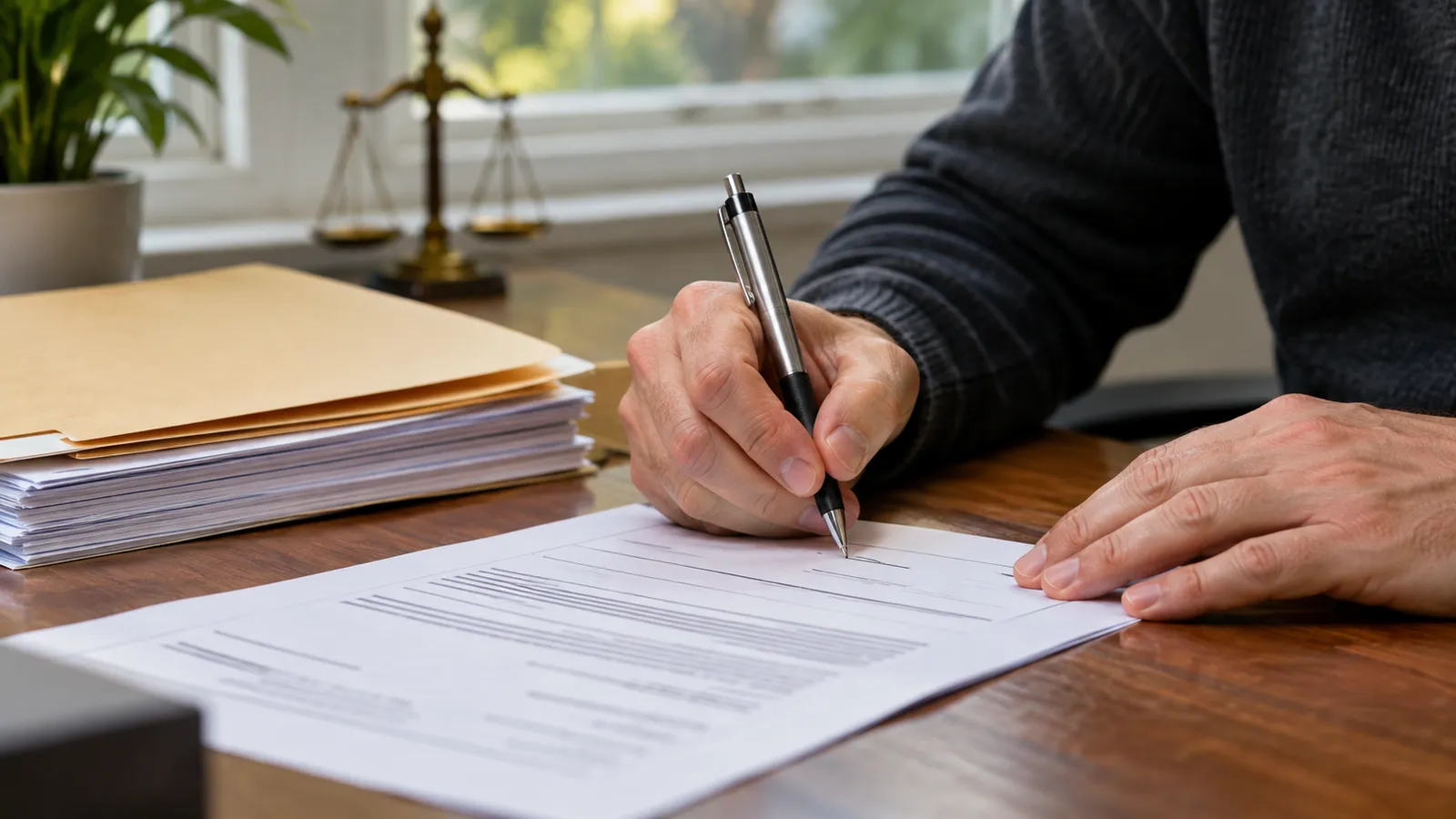
Fill out the financial form. The court will give you a sworn statement of your finances. Names vary: financial affidavit, affidavit of indigency, application for court-appointed counsel. In federal court it is form CJA 23. Some counties have a screener from the public defender office or pretrial services interview you in the jail before court.
Answer honestly. The form is signed under penalty of perjury. Leaving out a bank account or property can lead to a new charge and loss of your lawyer.
Ask for a delay if you need one. If no lawyer has been appointed yet and the judge asks you to plead, you can say you want to wait until you have a lawyer. Courts routinely reset the arraignment for this.
If you were released before court, call the public defender office in the county where the case is filed. Many offices let you apply ahead of the first court date, and some require it.
In some counties, people who are in custody get a public defender automatically at arraignment unless they already have a private lawyer. Others require the application first. The court clerk can tell you which rule applies.
- Write down the case number and the name of the courtroom or judge. You will need them to reach the assigned lawyer.
- If the judge denies your request, ask whether you can reapply if your finances change. Losing a job after the case starts is a common reason to reapply.
Who qualifies as indigent
There is no single national income cutoff. Each state, and sometimes each county, sets its own test. Many use a percentage of the federal poverty guidelines as a starting point. Judges also look at the full picture: income, cash, bank balances, property, debts, rent, child support, and how many people you support.
Courts also ask a practical question: could you actually hire a lawyer for this kind of case? A person with a modest paycheck may not qualify for a simple misdemeanor but may qualify for a felony where private lawyers charge much more.
You can qualify even if you have a job. You can be denied even if you are unemployed, for example if you own property or have savings. In federal court, guidance on the CJA 23 form says doubts about eligibility are resolved in the defendant's favor.
Bail money posted by family usually belongs to the person who posted it. Courts differ on whether they consider it. If a relative posts bond for you, tell the screener who paid it.
Some states have a partial indigency program. You get a public defender now, and the court decides after the case how much, if anything, you should repay based on your ability to pay.
Fees: is a public defender really free?
Often not completely. A July 2022 report by the National Legal Aid & Defender Association and the Fines and Fees Justice Center found that 42 states and the District of Columbia have laws that allow charging people for public defense. Eighteen states have upfront application or appointment fees, ranging from $10 to $400. Seventeen states allow both an application fee and a later recoupment charge for the cost of the lawyer.
Georgia is one example. State law sets a $50 application fee for people who apply for indigent defense, and the court must waive it if the person cannot pay or would face hardship.
Other states have moved the other way. California's AB 1869 removed courts' authority to order defendants to pay the cost of the public defender, starting July 1, 2021.
What this means in practice: ask the screener or clerk whether your county charges a fee and whether it can be waived. Not having the fee on hand should not stop you from getting a lawyer at your first hearing. If a recoupment order is entered at the end of the case, your lawyer can ask the judge to reduce or waive it based on ability to pay.
What happens at the arraignment
Most arraignments are short. The usual order is:
Identity and charges. The judge confirms who you are and that you received the complaint or charging document.
Rights. The judge explains your right to a lawyer, your right to remain silent, and, in many courts, your right to a preliminary hearing or jury trial.
Lawyer appointment. If you asked for a public defender and qualified, the judge appoints one. Sometimes the lawyer is in court that day. Sometimes the office is appointed and an attorney is assigned later.
Plea. Most people plead not guilty at arraignment, even if they expect to resolve the case later. A not guilty plea keeps your options open while your lawyer gets the police reports and other evidence.
Release or bail. The judge decides whether you are released on your own recognizance, released with conditions such as check-ins or a monitor, given a bail amount, or held without bail where state law allows. If bail was already set at an earlier hearing, your lawyer can ask to reduce it.
Next date. The judge sets the next hearing, such as a preliminary hearing, pretrial conference, or motion date.
What to say and not say in court and in jail
At arraignment, the judge is not asking for your side of the story. Answer the questions asked: your name, whether you understand, whether you want a lawyer, and your plea if you have counsel. Do not explain what happened. Anything you say in open court is on the record and the prosecutor is listening.
Talk about the facts only with your lawyer. Jail phone calls, video visits, and messages on jail tablets are usually recorded, except for calls to your attorney. Prosecutors use these recordings. Do not discuss the case with family on those lines.
If police want to question you, say clearly that you want a lawyer and will not answer questions without one. Then stop talking.
When you first meet the public defender, which may be a short meeting before court, tell them anything that bears on release: where you live and for how long, your job, children or relatives you care for, medical needs, and any past missed court dates. Ask them how to reach the office afterward.
What family members can do
Family cannot ask for a public defender for an adult defendant, and the lawyer cannot share details of the case with you without the client's permission. You can still help in ways that matter.
Find the court date. Look up the person on the county jail roster to get the booking number and charges, then check the court's online docket or call the clerk for the hearing time.
Gather release documents. A lease or utility bill showing a local address, recent pay stubs or a letter from an employer, and proof of medical or caregiving duties. Bring copies to court or ask the public defender office how to send them.
Show up. Being in the courtroom tells the judge the person has support and a place to go. Dress plainly and stay quiet.
Call the public defender office and give the case number. A name alone may not be enough to find the file. Offer the documents and a phone number where you can be reached. Keep it short.
Put money on the person's phone account so they can call their lawyer and arrange their affairs, but remind them not to talk about the case on those calls.
- If bail is set, ask the public defender whether a bail reduction motion is planned before paying a bondsman, since the premium you pay a bondsman is usually not returned.
Public defender vs. private lawyer
Public defenders are licensed attorneys with the same duties to clients as private lawyers. Many have handled more criminal cases in the local courthouse than most private lawyers, and they know the prosecutors and judges.
The main drawback is caseload. Your lawyer may have limited time for calls and visits. Be organized: write down your questions, keep copies of papers, and use the office's main number if you cannot reach your attorney directly.
You usually cannot pick which public defender you get. If there is a serious conflict, such as the office already representing a co-defendant or a complete breakdown in communication, you can ask the judge for a different appointed lawyer. Judges grant these requests only for good cause, not because you dislike the advice you are getting.
You can hire a private lawyer at any time. The new lawyer files a notice of appearance or substitution, and the public defender is released from the case.
Common questions
How long after arrest is the arraignment?
If you are held in jail after a warrantless arrest, a judge generally must review probable cause within 48 hours under County of Riverside v. McLaughlin, and weekends do not extend that. Many states set their own deadlines by statute or court rule. The plea-entering arraignment in felony cases can come later. If you were released, the date may be weeks away.
Can I get a public defender before my court date?
Often, yes. Call the public defender office in the county where the case is filed and ask how to apply. Some offices take applications in advance or have a lawyer at the jail before first appearances. If not, ask at the first hearing.
What if I make too much money to qualify but cannot afford a lawyer?
Tell the judge. Courts weigh income along with your debts, dependents, and the likely cost of a lawyer for your type of case. Some states have partial indigency programs where you get a public defender now and repay part of the cost later based on ability to pay.
Should I plead guilty at my arraignment?
Usually not without talking to a lawyer first. Most defendants plead not guilty at arraignment so their lawyer can review the evidence. A guilty plea can carry consequences beyond the sentence, such as effects on immigration status, housing, or a driver's license.
How do I find out who the public defender is on a family member's case?
Check the county court's online docket using the person's name or case number, or call the court clerk. You can also call the county public defender office with the case number. The office may confirm it represents the person but will not discuss the case without the client's consent.
Can I fire my public defender?
You can hire a private lawyer at any time, and the public defender will withdraw. Getting a different appointed lawyer requires asking the judge and showing good cause, such as a conflict of interest or a complete breakdown in communication.
Sources
- Gideon v. Wainwright, 372 U.S. 335 (1963), Cornell LII
- County of Riverside v. McLaughlin, 500 U.S. 44 (1991), Cornell LII
- Rothgery v. Gillespie County, 554 U.S. 191 (2008), Cornell LII
- Federal Rule of Criminal Procedure 5, Initial Appearance
- Federal Rule of Criminal Procedure 44, Right to and Appointment of Counsel
- U.S. Courts, CJA 23 Financial Affidavit
- Fines and Fees Justice Center, At What Cost? Public defense system fees (2022)
- Fines and Fees Justice Center, California AB 1869
General information, not legal advice. Laws and court rules differ by state and change; for a specific case, talk to a lawyer licensed in that state.