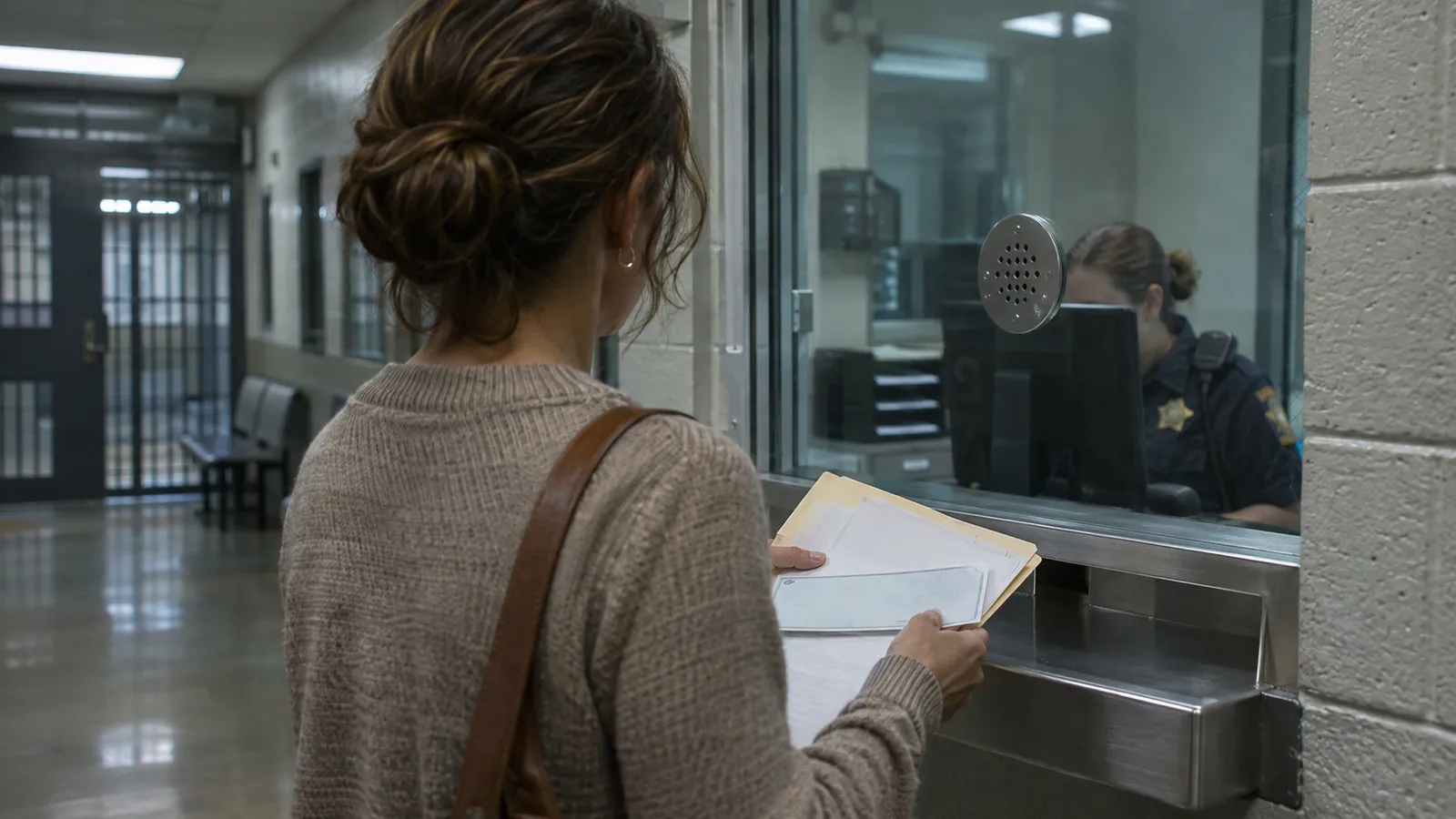
A bail bond is a promise to the court, backed by an insurance company, that the full bail will be paid if the defendant skips court. You pay a licensed bail agent a nonrefundable premium, often around 10% of the bail, and may pledge collateral and sign an indemnity agreement. If the defendant misses court, the agent and anyone who signed can end up owing the full amount.
The short answer
When a judge sets bail at $20,000, someone has to guarantee that amount. You can pay it all in cash to the court. Or you can hire a bail agent, often called a bondsman, who guarantees it for you.
The bail agent does not hand the court $20,000. The agent files a bond, which is a written promise that the money will be paid if the defendant fails to appear. In return, you pay the agent a fee called a premium. You may also put up collateral and sign a contract promising to repay the agent for any loss.
If the defendant goes to every court date, the bond is released when the case ends and your collateral comes back. The premium does not. If the defendant skips court, the court can order the bond forfeited, and the agent will look to the people who signed to cover it.
This guide covers how the bond itself works. For the practical steps of getting someone released, see our guide on how to bail someone out of jail.
What a surety bond is
A bail bond is a type of surety bond. It ties together three parties. The defendant (called the principal) promises to appear. The surety, usually an insurance company, promises to pay if they do not. The court is the party the promise is made to.
The bail agent you meet in the office is licensed by the state and appointed by that insurance company to write bonds on its behalf. For each bond, the agent attaches a document from the insurer, often called a power of attorney, that tells the court which company stands behind it and up to what amount.
The court does not care how the agent got paid. It only cares that someone solvent has promised the full amount. That is why the agent asks so many questions about the defendant, the family and their jobs before agreeing to write the bond. The agent is taking on the risk of a large loss for a fee of a fraction of that amount.
Premium vs. collateral
People often mix these two up. They are different payments with different rules.
The premium is the agent's fee for writing the bond. It is often around 10% of the bail amount, though states set it differently. In California, sureties must file their rates with the Department of Insurance and agents must charge those filed rates. Florida law makes it a crime for an agent to charge more or less than the filed rate. The California Department of Insurance says plainly that premiums are not refunded even if charges are dropped.
Some agents used to charge the premium again each year a case stayed open. California banned these renewal premiums starting January 1, 2022 (Penal Code 1276.1). Other states vary, so ask whether there is any renewal charge and get the answer in the contract.
Collateral is security for the full bond amount, not a fee. It can be cash, a car title, a lien on a house or other property. The agent holds it in case the defendant skips and the company has to pay. When the bond is released, the collateral is supposed to come back.
Florida spells out how collateral must be handled in Statute 648.442. The agent must give a written, numbered receipt listing what was taken. Collateral is held in trust and cannot be used for the agent's benefit. It must be returned when liability on the bond ends. If the bond is forfeited and the agent plans to sell the collateral, the agent must give at least 10 days' written notice by certified mail, and the owner gets back anything above the bond amount, minus reasonable costs. Florida also bars agents from taking a quitclaim deed as collateral.
- Get a separate receipt for the premium and for the collateral, and keep the signed contract.
- Ask in writing when and how collateral will be returned after the case ends.
The indemnity agreement and what co-signers owe
Almost every bail agent asks a friend or relative to sign an indemnity agreement. The person who signs is called the indemnitor or co-signer. This is the document that carries most of the risk for families.
By signing it, you promise to repay the bail company for any money it loses on the bond. If the defendant misses court and the bond is forfeited, the company can come to you for the full bail amount. Most agreements also make you pay the cost of finding and returning the defendant, plus court costs and attorney fees.
The agreement often goes further than people expect. It may let the agent sell your collateral, place a lien on your property or sue you. It may also give the agent the right to surrender the defendant to jail if the agent believes the risk has gone up, such as when the defendant moves without telling anyone or stops checking in.
You are not on the hook for the defendant's criminal case. You are on the hook for the money. Read every page before signing, and ask the agent to explain any clause you do not understand. You can also ask to be released as an indemnitor later, but the agent usually has no duty to agree. If you want out, the agent may surrender the defendant instead.
- Only co-sign for someone you trust to make every court date. You are betting the full bail amount, not the premium.
What the bail agent does after release
After the bond is posted, the agent's job is to make sure the defendant shows up. Contracts often require the defendant to check in by phone or in person, report any address or job change, and get permission before leaving the state. Some agents send court-date reminders.
If the agent thinks the defendant may run, the agent can surrender them to jail before any missed court date. This ends the agent's liability on that bond. States limit how this works. The California Department of Insurance says agents cannot surrender a defendant for failing to pay the premium, and that when a defendant is surrendered, the premium is refundable minus administrative costs under state regulations.
If a defendant is surrendered, they are back in custody. They can be released again only if a new bond is posted or a judge sets new terms.
Bond forfeiture and remission
If the defendant misses a required court date without a good excuse, the judge declares the bail forfeited and usually issues a warrant. Forfeiture is not the end of the story. Most states give the surety a window to bring the defendant back before it has to pay.
In California, under Penal Code 1305, the clerk must mail a notice of forfeiture within 30 days when the bond is over $400. The surety then has 180 days, plus 5 days for mailing, to get the defendant back to court. If the defendant appears, is arrested or is surrendered in that window, the court must vacate the forfeiture and release the bond. If the clerk fails to mail the notice on time, the surety is released from the bond.
Florida works differently. Under Statute 903.27, if a forfeiture is not paid or discharged within 60 days, the clerk can enter judgment against the surety. The surety then has 35 days to pay. An agent with a judgment unpaid for 35 days cannot write new bonds until it is paid.
Even after paying, a Florida surety can get money back through remission under Statute 903.28. The court can return up to 100% of the forfeiture if the defendant is returned within 90 days, 95% within 180 days, 90% within 270 days, 85% within one year and 50% within two years. This is why agents work hard to find a missing defendant quickly. Every month costs them money, and that cost gets passed on to the co-signer.
- If the defendant missed court by mistake, call the bail agent and a defense lawyer right away. Turning up fast is the cheapest fix for everyone.
Bail recovery and bounty hunters
When a defendant skips, the bail company may hire someone to find and return them. The old rule comes from Taylor v. Taintor, an 1872 U.S. Supreme Court case that described a surety's broad power to arrest its principal. States have since added their own rules, and some have narrowed that power a lot.
California requires a license. Under Penal Code 1299.02, only a peace officer, a bail agent who is also licensed as a bail fugitive recovery agent, a licensed bail fugitive recovery agent, or a licensed private investigator who also holds that license can arrest a bail fugitive. The Department of Insurance says recovery agents must be licensed as of July 1, 2023, and carry at least $1,000,000 in liability insurance.
Florida goes further. Statute 648.30 makes it a crime to call yourself a bail enforcement agent or bounty hunter in Florida. Apart from law enforcement, only a licensed and appointed bail agent, or someone holding an equivalent license from the state where the bond was written, can arrest a defendant on a bond. Violating the law is a third-degree felony.
In Illinois, Kentucky, Oregon and Wisconsin there is no commercial bail industry at all, so there are no bail bond recovery agents working those cases. Other states fall somewhere in between. Our page on state bail regulations covers those four states and how bail works there.
When the bond ends
A bond ends when the court exonerates it. That means the court releases the surety from its promise. It usually happens when the case is dismissed, the defendant is found not guilty, or the defendant is sentenced. It can also happen when the defendant is surrendered or taken into custody on the case.
Exoneration matters to you for one reason: collateral. The agent usually will not release collateral until it has proof the bond was exonerated. Ask the court clerk for a copy of the order or the docket entry, send it to the agent, and follow up in writing.
The premium is not returned at exoneration. That money was the agent's fee from the start.
How to check a bail agent's license
In most states that allow commercial bail, bail agents are licensed by the state insurance department or a similar agency. Ask the agent for a license number, then look it up on the agency's website before you pay anything.
In California, the Department of Insurance has a license status lookup for individual bail agents and a list of active bail licensees by county. In Florida, bail bond agents are licensed by the Department of Financial Services. Texas is an exception. In larger counties, bail bond sureties are licensed by a county bail bond board, which keeps a list of approved bondsmen, so you check with the county instead of the state.
A lookup tells you whether the license is active and, in many states, which insurance company appointed the agent. It may also show past discipline.
Red flags
Walk away, or at least slow down, if you see any of these:
• An agent who approaches you at the jail, the courthouse or the police station without being called. The California Department of Insurance says agents cannot solicit business this way.
• An agent who got your name and number from someone other than the arrested person or their lawyer. In California it is illegal for an agent to contact a friend or relative unless the arrested person asked.
• A price far below or above what other licensed agents in the state charge. In states with filed rates, the premium should not vary much.
• No written contract, no receipt, or a request to pay in cash with nothing in writing.
• Pressure to sign over a house deed, or a contract that does not explain when collateral comes back.
• A license number that does not show up in the state lookup, or a name that does not match the license.
If something goes wrong, file a complaint with the state insurance department or, in Texas, with the county bail bond board.
Common questions
How much does a bail bond cost?
Often around 10% of the bail amount as a premium, so about $2,000 on a $20,000 bail. Some states set or approve the rate. The premium is not refundable, and the agent may also ask for collateral worth up to the full bond.
Do you get bail bond money back?
You do not get the premium back, even if charges are dropped. Collateral should be returned after the court exonerates the bond, as long as the defendant made every court date and nothing is owed under the contract.
What happens to the co-signer if the defendant skips bail?
The co-signer can owe the bail company the full bond amount, plus the costs of finding the defendant and any fees the contract lists. The company can use collateral and, if needed, sue. The co-signer is not charged with the defendant's crime.
Can a bail bondsman revoke a bond?
Yes. A bail agent can surrender the defendant to jail before trial, which ends the agent's liability. Contracts usually allow this if the defendant breaks the contract terms. Some states limit it. California does not allow surrender just for an unpaid premium.
What is the difference between a bail bond and bail?
Bail is the amount the court sets. A bail bond is a promise from an insurance company, written through a licensed bail agent, to pay that amount if the defendant does not appear. You pay the agent a premium instead of paying the full bail yourself.
Sources
- California Department of Insurance: Bail bonds
- California Penal Code 1305, Forfeiture of bail
- California Penal Code 1299.02, Bail fugitive recovery
- Florida Statutes 648.442, Collateral security
- Florida Statutes 648.30, Licensure and appointment required
- Florida Statutes 903.27, Forfeiture to the state
- Florida Statutes 903.28, Remission of forfeiture
General information, not legal advice. Laws and court rules differ by state and change; for a specific case, talk to a lawyer licensed in that state.